The Expansions
The engine is complete on its own. An expansion is optional: a second source of return that rides beside it, off until you switch it on. None is sold on a backtest; each earns its place here, in public, first.
What held up after every correction we could throw at it. Backtests from $10,000, not promises; each line names its window.
Available when the bitcoin & gold expansion goes on sale.
₿+AuBTC + AU
The engine. Optional additions.
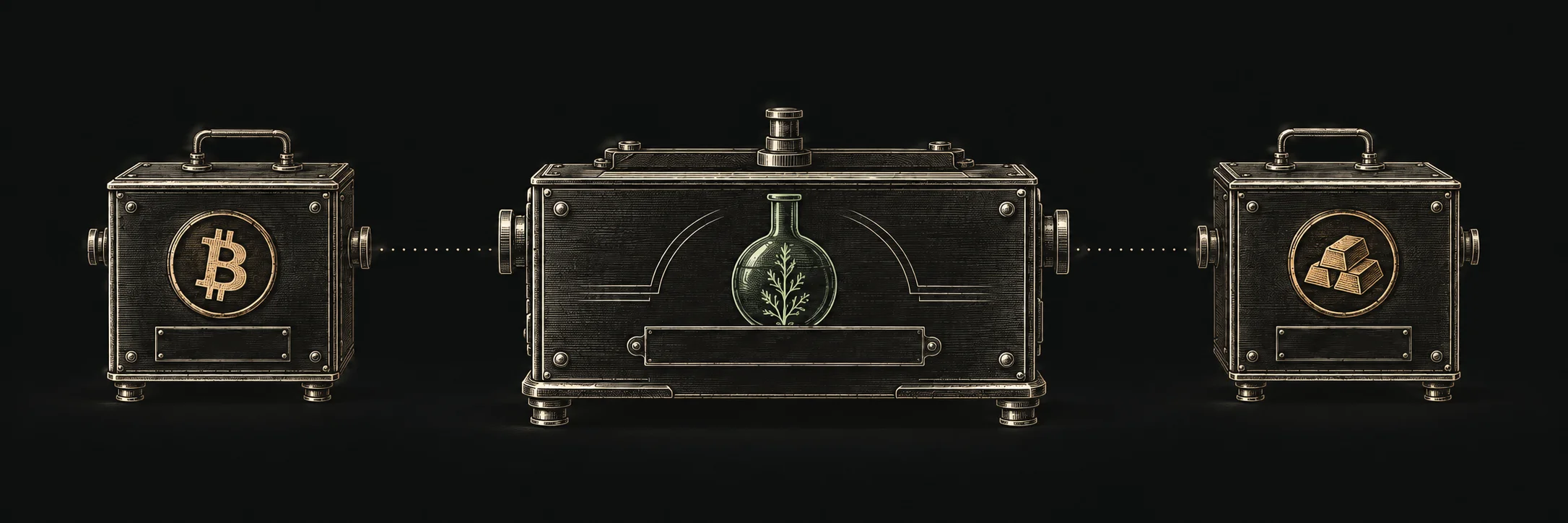
Expansion candidate — not for sale. Available only after its release gates pass.
The same file, three ways
Bitcoin alone earns the most in a bull market and falls a little further than the engine. The pair gives up about two points a year for a shallower fall, lower volatility, the best Sharpe in every window, and the only version that kept working in the correlated era.
| setting (engine / bitcoin / gold) | since 2018 | 2020–2026 | 2022–2026 |
|---|---|---|---|
| the engine alone | 21.8%/yr · −27% · Sharpe 0.92 | 23.0%/yr · −27% · 0.96 | 17.1%/yr · −27% · 0.79 |
| bitcoin alone · 80 / 20 / 0 | 24.9%/yr · −28% · 1.05 | 29.4%/yr · −28% · 1.19 | 20.3%/yr · −27% · 0.95 |
| gold alone · 80 / 0 / 20 | 19.8%/yr · −23% · 0.98 | 21.2%/yr · −23% · 1.03 | 17.5%/yr · −21% · 0.91 |
| ₿Au together · 60 / 20 / 20 recommended | 23.0%/yr · −25% · 1.13 | 27.7%/yr · −25% · 1.30 | 20.8%/yr · −19% · 1.11 |
| together, less bitcoin · 70 / 10 / 20 | 21.9%/yr · −23% · 1.10 | 24.4%/yr · −23% · 1.19 | 19.0%/yr · −20% · 1.02 |
Return a year · worst fall · Sharpe. The same add band, cut and volatility estimator the live engine uses, every signal read at a close and filled the next session; pre-tax, commissions in. Volatility: the engine alone 25, bitcoin alone 24, the pair 20. Filled at the next open instead of the next close, which is what the package does (the founder’s own account runs at 7:45 AM Pacific, seventy-five minutes into the session), every book above moves by less than a third of a point a year since 2018 and since 2020, and earns about three quarters of a point a year less since 2022 (the pair 20.2% instead of 20.8%). This is a partial comparison: the bitcoin sleeve is the same in both, since no exchange open exists for it before 2024; the adverse-gap stress below supplements that, it does not replace it. A cash account cannot spend the same day’s sale proceeds or borrow for a month-end top-up. Funded on settled cash, modelled on the founder’s executor’s own budget rule (sale proceeds usable the next session, a buy batch shrunk to what ninety-nine percent of settled cash affords, cheapest leg first, a sleeve top-up deferred whole until cash covers it; the buyer package defers a whole batch instead, a different path not modelled here), the books above earn up to a point and a half a year less, the pair a quarter of a point less since 2018 (22.8%) and about a point less since 2022 (19.7%), bitcoin alone about the same, with settled cash never below zero on any session. The engine alone loses about a point and a quarter a year to the same rule since 2018; the front-page engine figures are computed under it.
How an expansion unlocks
Not by waiting for a regime that may take a decade, and not by a sales date. The backtest already carries the harshest tests the history allows; more paper months prove nothing. The gate asks one thing: does the real machinery execute the frozen rule exactly, on real dates, prices, weekends, restarts and a small account? That takes events, not months. The rehearsal part is done: every path the code has was run on a paper broker under simulated clocks and injected faults. What remains cannot be rehearsed, only observed, and it is four things.
- pendingSixty days of unattended operationcounting from 2026-09-03; the earliest finish is November 2
- pendingTwo natural month-end reads, each checked against an independent price sourceOctober 1 and November 2
- ✓ 2026-09-07 (holiday half): the Labor Day 07:45 run refused with 'the exchange is closed today (IB liquidHours)' and stamped nothing; the weekend month-end half waits for November 2One real weekend or holiday month-endOctober 31 is a Saturday; the read lands Monday November 2
- pendingIts paper record reconciled to the broker, with nothing unexplainedpositions, cash and fills, to the cent
All boxes ticked, it becomes an expansion: optional, another return stream beside the engine, never a mode. It comes with every licence at no extra cost, off until you switch it on. 5% first. The rolling gap in the evidence below stays as the falsifier. Nothing is tuned while it sits here.
Read the full evidence for Bitcoin & Goldthe sleeves one by one, sizing, every bitcoin fund compared, the audit, the bears it never saw
The evidence
Everything below is what the expansion stands on, in the order it was found: the bitcoin sleeve alone, then bitcoin and gold together, then the operational gate that decides the date.
₿ULTRA with a bitcoin sleeve
In one breath. One hundred and eighty-seven ideas died in testing. This is the first that beat the engine at equal drawdown on every window its asset has, survived two agents built to kill it, and came through the 2011 collapse and every cycle top still standing. Since the spot funds listed in January 2024 it has out-earned every one of them at half their drawdown; on the older funds’ own windows two out-earned it, and the table below shows both. It may be the best sleeve this product will ever have. It is still not sold: eleven years is one regime, the edge moves with bitcoin’s drift, and the last year was negative. So it earns its way in on paper, one box at a time.
| window | what it says | ULTRA | ULTRA + bitcoin sleeve |
|---|---|---|---|
| since 2018 | bitcoin’s history after its first hyper-growth era; 24.9% a year against 21.8%, a point more drawdown | 21.8%/yr · worst −27% | 24.9%/yr · worst −28% |
| 2020–2026 | the last two bitcoin cycles; 29.4% a year against 23.0% | 23.0%/yr · worst −27% | 29.4%/yr · worst −28% |
| 2022–2026 | the correlated era; 20.3% a year against 17.1%, and the two most recent years behind the engine | 17.1%/yr · worst −27% | 20.3%/yr · worst −27% |
Sized at 5, 10 and 20%, with the engine dialled back to its own drawdown
The engine is turned down until the book’s worst drawdown matches the engine alone, so the two columns compare like with like. What is left is the sleeve’s return.
| sleeve | since 2018 (engine alone 21.8%/yr) | 2022–2026 (engine alone 17.1%/yr) |
|---|---|---|
| 5% | 22.6%/yr · Sharpe 0.97 vs 0.92 | 18.1%/yr · Sharpe 0.84 vs 0.79 |
| 10% | 22.9%/yr · Sharpe 1.00 vs 0.92 | 18.6%/yr · Sharpe 0.87 vs 0.79 |
| 15% | 23.8%/yr · Sharpe 1.03 vs 0.92 | 19.3%/yr · Sharpe 0.91 vs 0.79 |
| 20% | 24.3%/yr · Sharpe 1.06 vs 0.92 | 20.2%/yr · Sharpe 0.95 vs 0.79 |
Same picture matched on volatility. The engine barely had to move to re-match risk: it adds return at nearly unchanged book risk. Worst rolling year about three points deeper since 2018; the worst 1% of days smaller at every size.
Against every bitcoin fund a US account can buy
Each fund on its own listed history, total return with distributions reinvested; in the last column, the sleeve alone on exactly the same days. The first two rows and the headline card share one window, from the day the spot funds listed.
| vehicle | what it is | return · worst · Sharpe | the sleeve, same days |
|---|---|---|---|
| spot bitcoin | the coin, held · since Jan 2024 | 23.4%/yr · −53% · 0.68 | 24.5%/yr · −26% · 0.76 |
| IBIT · FBTC · ARKB · BITB · HODL | spot funds, held, 0.20–0.25% fee · since Jan 2024 | 22.8%/yr · −53% · 0.66 | 24.5%/yr · −26% |
| BITC | Bitwise rotation: bitcoin futures or Treasuries on a 10/20-day average, 0.85% · since Mar 2023 | 29.5%/yr · −33% · 0.83 | 23.0%/yr · −26% |
| GBTC | the Grayscale trust, 1.5%, premium and discount included · since Jun 2015 | 59.9%/yr · −90% · 0.98 | 56.1%/yr · −75% |
| BITO · BTF | futures, held; pays the roll · since Oct 2021 | −2.2%/yr · −78% · 0.23 | 12.1%/yr · −40% |
| BITX | 2x daily, pays volatility decay · since Jun 2023 | 13.2%/yr · −83% · 0.61 | 21.9%/yr · −26% |
| BITU | 2x daily, ProShares · since Apr 2024 | −23.2%/yr · −83% · 0.20 | 8.1%/yr · −26% |
| YBTC | covered calls on bitcoin: sells the upside · since Jan 2024 | 7.8%/yr · −49% · 0.39 | 28.1%/yr · −26% |
| BTCI | NEOS bitcoin income, covered calls · since Oct 2024 | 5.2%/yr · −48% · 0.33 | 20.4%/yr · −26% |
| BLOX | Nicholas crypto income: bitcoin and ether funds plus crypto stocks, calls sold · since Jun 2025 | 4.9%/yr · −47% · 0.36 | 2.7%/yr · −15% |
| BTCC | Grayscale bitcoin covered call · since Apr 2025 | −14.7%/yr · −44% · −0.37 | 8.4%/yr · −15% |
| MAXI | bitcoin plus option income · since Sep 2022 | 30.7%/yr · −69% · 0.74 | 25.6%/yr · −26% |
| MSTR | Strategy, the bitcoin treasury company, held · since Jun 2015 | 18.9%/yr · −89% · 0.60 | 56.1%/yr · −75% |
| MSTY | YieldMax calls on Strategy · since Feb 2024 | 15.0%/yr · −77% · 0.55 | 18.6%/yr · −26% |
| BITW | Bitwise 10, the ten largest coins · since Dec 2020 | 5.8%/yr · −96% · 0.47 | 31.3%/yr · −52% |
| BITQ · IBLC · STCE | crypto-industry stocks (miners, exchanges, treasuries) · since May 2021 | 1.9%/yr · −90% · 0.36 | 11.3%/yr · −40% |
| ETHA | spot ether, held · since Jul 2024 | −16.2%/yr · −68% · 0.10 | 9.0%/yr · −26% |
Every fund but one is packaging, and packaging costs: the futures roll ~5pp/yr, 2x funds 20–30, covered calls 15–20 in a rising market. The proxies — the treasury company, miners, the ten-coin basket, ether — are worse than the coin with deeper holes. Two honest exceptions: income funds held up better in the falling stretch since mid-2025, and BITC out-earned the sleeve over its life because its first eighteen months were a plain futures fund in a bull; since it became a trend fund in December 2024 it is −9.7%/yr at −33% against the sleeve’s −0.3% at −26%. Since 2018 the sleeve alone trails the coin, 17.8% to 20.9%: the exit buys a smaller drawdown with return. What no fund sells is the sizing.
What the audit found
- It exits exactly the days that hurt. When bitcoin falls with the NASDAQ, the rule is out. That state was a fifth of all days since 2018, at about −31% a year.
- Bad fills do not kill it. A 5% adverse gap on every trade still leaves the book about a point a year ahead of the engine.
- Two agents attacked it and found a bug. Fixed; every number here is from the corrected run. Every faster version of the rule died with the fix.
- The number is a range. Shift the monthly read and it moves about three points. Twenty-five alternatives, leverage and ether included, did not beat it.
Why it is here and not on the core page
Bitcoin has eleven years of price: one regime, two bears, no decade of going nowhere. The edge sits at the 64th percentile of its own bootstrap and moves with how much bitcoin drifted (correlation 0.78). In the regime since 2022, bitcoin moving with the NASDAQ, the median edge is a third of a point and 2025 and 2026 are both negative. A true 200-calendar-day average halves it; the vehicle a US account could hold before 2024 would have earned about half a point. So it sits here, and the regime gets to vote.
The bears the sample never saw, and the entries nobody would choose
On 2010–2014 prices no account could trade: in the 2011 collapse, $29 to $2, the rule read its exit 83% off the peak and the sleeve lost 84% against the coin’s 93%. A parabolic top beats a monthly rule. In the slower 2013–15 bear it left 58% down and avoided the next 62%. Bought at the worst days: from the December 2017 peak the book returned 22.9% a year with a 10% sleeve and 24.2% with 20%, against 21.4% for the engine alone; from the November 2021 peak 18.1% and 18.8% against 17.6%; from the October 2025 peak, the eleven months now running, 14.4% and 8.6% against 20.0%. Every era alone, and the record with any era removed, is positive; the size moves from under two points to over forty. That is why the edge is a range, never a number.
Where the code stands: the sleeve exists in the live engine and the sold package as a setting that is off, so the gate tests the code a buyer would run. Setup does not offer it until every box is ticked; then it is an optional expansion, never a default.
₿+AuULTRA with a BTC + gold sleeve
In one breath. Gold is the drawdown lever and bitcoin is the return lever, and they barely move together. Together, sixty percent engine and twenty of each, they make the best book this program has tested: more return than the engine at less risk, in every window. Gold’s own history is fully in the record: the same rule survived its twenty-year bear in the STEADY tests, so the only thing this seat waits on is the machinery, which it shares with seat 1. Right now gold sits below its average and the sleeve is in cash: the first thing it did was nothing, which is the rule.
| book (ULTRA / bitcoin / gold) | since 2018 | 2020–2026 | 2022–2026 |
|---|---|---|---|
| 80 / 0 / 20 | 19.8%/yr · −23% | 21.2%/yr · −23% | 17.5%/yr · −21% |
| 75 / 5 / 20 | 21.1%/yr · −23% | 23.3%/yr · −23% | 18.7%/yr · −20% |
| 70 / 10 / 20 | 21.9%/yr · −23% | 24.4%/yr · −23% | 19.0%/yr · −20% |
| 60 / 20 / 20 best | 23.0%/yr · −25% | 27.7%/yr · −25% | 20.8%/yr · −19% |
| the engine alone | 21.8%/yr · −27% | 23.0%/yr · −27% | 17.1%/yr · −27% |
Both sleeves built the same way, every signal read at a close and filled the next session, the engine leg on the product’s own band and estimator, pre-tax, commissions in; every book above earns more than the engine at the same or less risk. Filled at the next open rather than the next close (the fund legs; bitcoin has no open before 2024), each book above moves by under a third of a point a year since 2018 and about three quarters of a point less since 2022; funded on settled cash under the founder’s executor’s budget rule, by up to a point and a half less (the pair 22.8% since 2018). Gold takes four points of volatility and four of drawdown out of the book; bitcoin adds return; in the correlated era the pair beats the sum of its parts because the years bitcoin sat in cash were years gold ran. The 60 / 20 / 20 book is the best of the family on every measure and is the one on paper below; the 70 / 10 / 20 row is its calmer sibling for anyone who wants half the bitcoin. The fund is SGOL, about $43 a share, so a $4,000 account holds eighteen shares rather than one of GLD.
The engine’s own ladderaccount sizes, and the futures engine that waits on its own record
Built to grow into more.
Most strategies decay as accounts grow. This one runs the other way — its future upgrades are gated by lot sizes, not by missing ideas, and each one unlocks as the account earns it.
And a small account is not a compromise, though it is no longer free. We ran the engine at $3,000, $5,000, $10,000 and $25,000 over the same full cycle 1999–2026 as every other figure on this page, dot-com crash included, on settled cash only. STEADY earns 11.4% a year at $3,000 and 12.0% at $25,000; SELECT 14.5% and 15.0%; ULTRA 17.2% and 17.3%. The gap is whole-share rounding and commissions against a book that must wait for cash to settle before it buys, and it is about half a point a year at the smallest size on the two calmer engines. The rungs below exist because the next instruments have minimum ticket sizes, not because the engine works better with more money. One caveat, stated because it matters: the levered instrument the engine uses did not list until 2006, so 1999–2006 models it from the published 2x rule with the short rates of the day. That model was checked against the real instrument over the twenty years where both exist — 0.995 daily correlation, no directional bias, and it runs slightly behind the real thing rather than ahead.
The futures engine is a separate product, and it is not sold yet, and neither is any sleeve. Improvements to The Distillate itself stay free to every licence, forever; expansions — optional, separately validated return streams — come with every licence at no extra cost, each as a switch the day it clears its gate. The futures engine is its own strategy with its own research and its own kill log — and it waits on a live forward record before it is offered at all. Nothing here is sold on a backtest.
Deposits rebalance for free. The engine re-reads your actual positions before every decision, so new cash simply lowers your measured exposure and the next run buys toward target — a rebalance with no sale, no commission on the way out, and no tax event. Adding money is not just fuel; it is the cheapest rebalancing the strategy ever does. Planned founding pricing when they land: $249, or The Graduation — the Distillate plus the futures engine — for one bundled price, with whatever you already paid credited in full. No number is final until a product actually ships.
What did not make it
Pre-tax, bills on cash, commissions in, every signal executed the day after it is read. The evidence page · the live record.